


We're two weekends into the college football season, which means my Saturdays are spoken for and the Fort Lauderdale humidity is crushing my spirit.
But in my head, it’s fall.
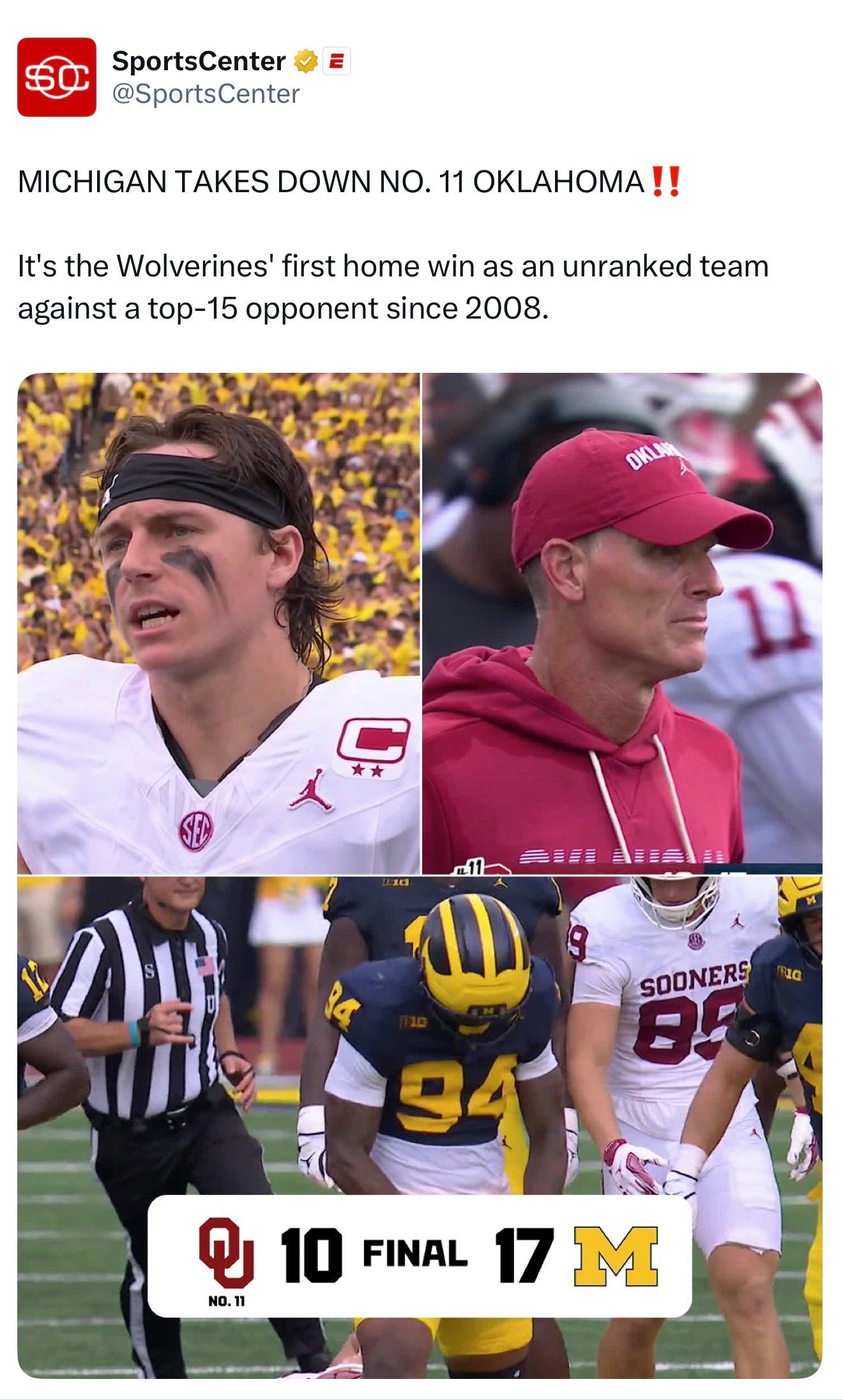
Which means I just watched Michigan slap Oklahoma without needing to put an extra second on the clock! A miracle.
(The Sooners are a storytelling partner; praying they don’t read my blog.) 🤞
And tomorrow I have a Lions/Saints game I’ve waited for all offseason.
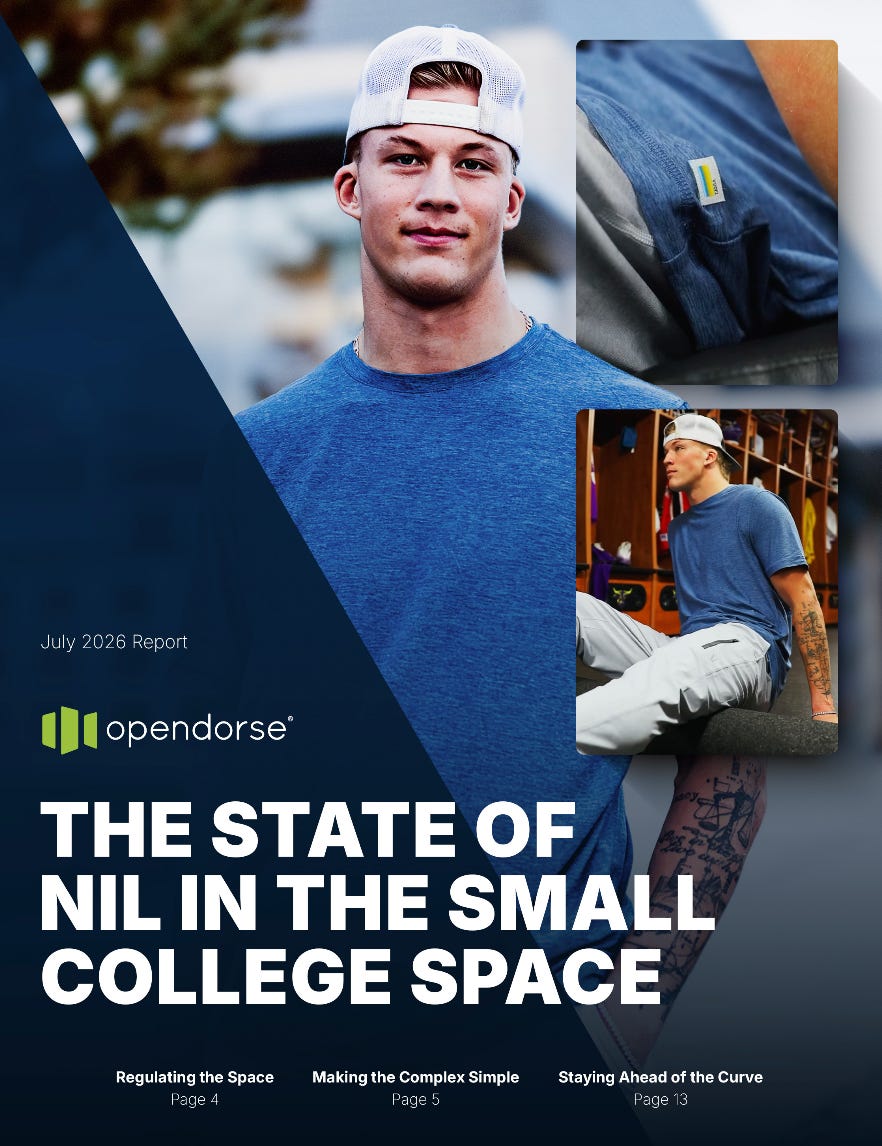
Sitting and watching football means it was a good time to digest the latest Opendorse offering: “The State of NIL in the Small College Space.”
Back in June I wrote up the Opendorse Annual NIL Report (see below) and spent about a third of the post on one complaint: the data was completely geared toward NCAA Division I athletes and nobody else. No DII, no DIII, no NAIA, no NJCAA.
New: Opendorse Releases 2026 Annual NIL Report

As we creep toward July 4th, I hope you’re soaking up every moment of sun and summer. ☀️
And now we have their newest offering.
I would love to tell you my newsletter shamed them into it, but I do not have that kind of power and am therefore 0% responsible.
The report was almost certainly in layout before my post ever went out, but I’ll take the timing.
🎉 Good news! The small-college report is a very different document from the annual one. Shorter (14 pages), lighter on numbers, heavier on explainers. It does read like it was written for an AD who has never had an NIL conversation, for what it’s worth. Let’s go through what it says… and then let’s talk about it big-picture.
Total non-D1 NIL market size? $25 million
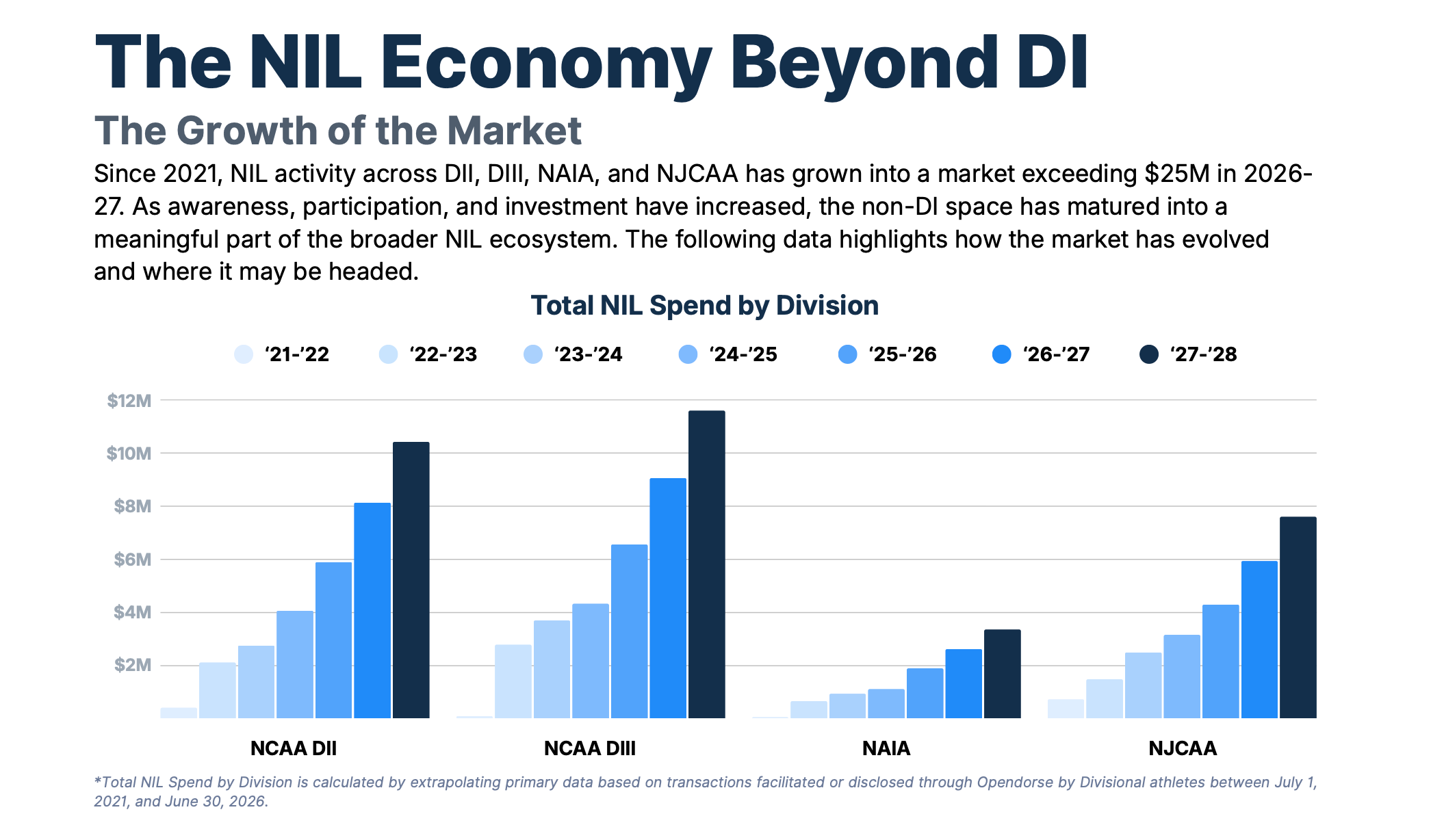
Opendorse puts NIL activity across DII, DIII, NAIA, and NJCAA at a market “exceeding $25M” for 2026-27.
If you’re wondering, the Division I number from the June report was $4.5 billion with a B. Now… I was never an accounting major, but I believe the small college amount represents — um — about a half of one percent of it.
If you rounded the DI market to the nearest hundred million, the entire small-college economy would disappear.
Cool, cool. Eeep.
Division III is the biggest of the four, which makes sense if you consider that it’s the largest division by total number of institutions — 422 to 429. Don’t ask me how that isn’t an exact number. 😂
Eyeballing it, DIII lands somewhere around $9 million this year, DII a bit under that, NJCAA in the $6 million range, and NAIA closer to $2 million — meaning that DIII doesn't give out a dollar of athletic money and it's still the biggest spender of the four.
The 2027-28 projections push every division up again, with DIII cresting near $12 million. Opendorse projections have historically run conservative, if the June revision is any guide.
Small college NIL is on the up-and-up
Opendorse says 13x more NIL deals happened in year five (the 2025-26 academic year) than in the first four years of NIL combined. (See page 8 of the report.)
Thirteen times!
Let’s count the athletes on Opendorse with at least one commercial deal:
NCAA DII: 728 in 2024-25 → 4,777 in 2025-26
NCAA DIII: 539 → 5,241
NAIA: 448 → 6,514
NJCAA: 177 → 2,529
Add them up and you go from 1,892 athletes to 19,061 in a single year.
Look at NAIA for a second. It has the most athletes doing commercial deals (6,514) and the smallest total spend (around $2 million). That’s a lot of people doing a lot of very small things, which brings us to…
Small-coll NIL deals look like this ⬇️
The average Division I deal in the report earlier this summer was $6,200. Those deals were often one-offs, cash value, on a four-day turnaround.
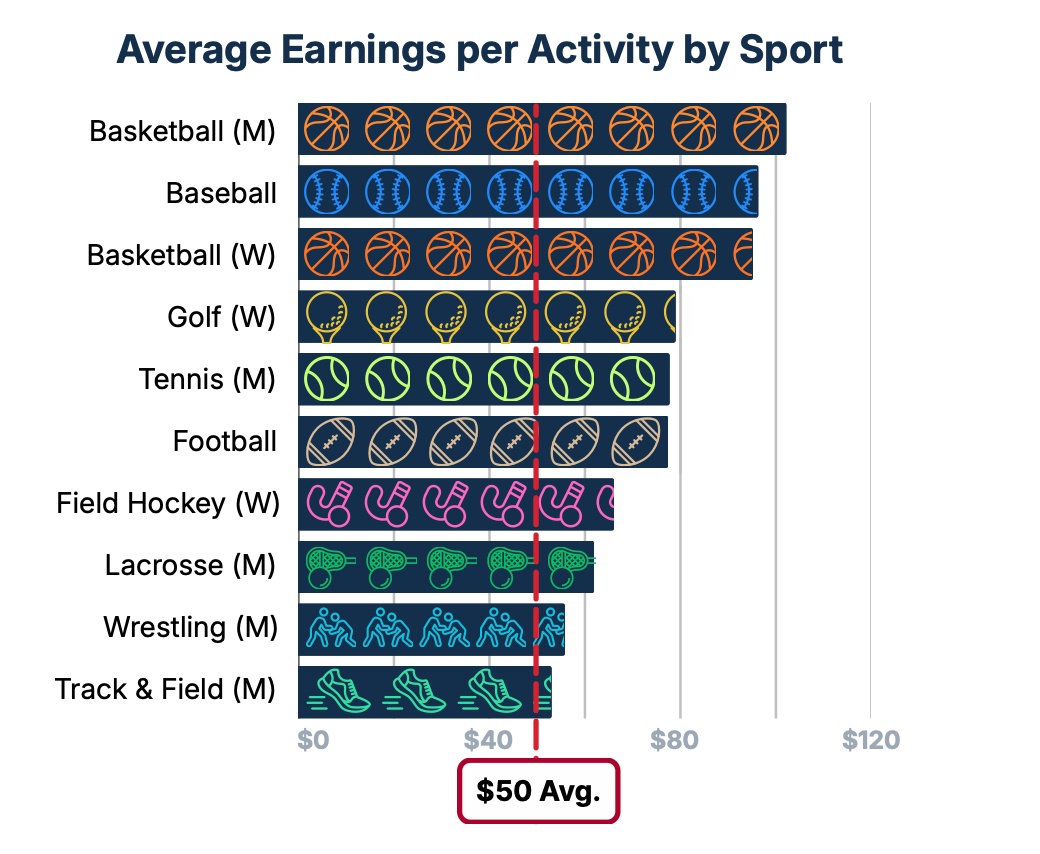
The small-college report does not give an average deal size, but it does give average earnings per activity. And that number is $50.
Fifty bucks. 💸
Men’s basketball sits highest on the chart, slightly north of $100 per activity, with baseball and women’s basketball close behind.
Football, which does dominate total dollars, sits below all three on a per-activity basis. Men’s track and field brings up the rear of the top ten right around the average.
That’s a free meal at whatever a Runza is (don’t hate me people of Nebraska), or a Casey’s gift card, or a Quest bar and a story post.
And to be clear, I think that’s fine.
Kyle Deaton, founder of the Big Red Collective at Carthage College, is quoted in the report saying they aren’t trying to change anyone’s future with huge deals; the goal is to “bridge the gap between financial aid and the cost to live.”
I appreciate the candor.
At the small college level, schools aren’t buying QBs or point guards. The opportunity is creating moments for student-athletes already on campus to cover gaps in their meal plan in exchange for a story post.
Comparing NIL within divisions.
Alright class, let’s turn our small college NIL textbooks to page four.
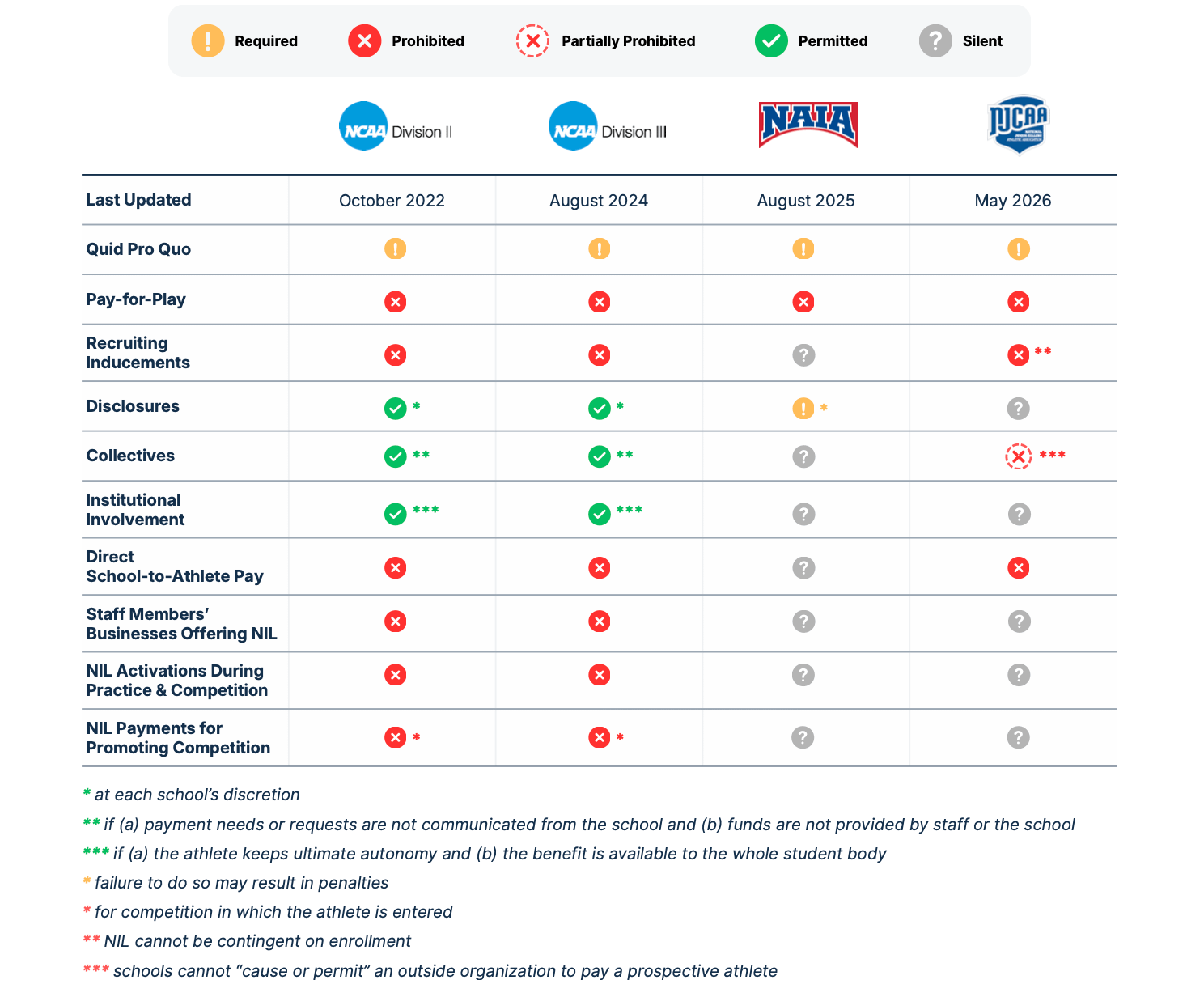
As you can see, each association and division sets its own NIL rules. And if the 'last updated’ row is any indication, there’s probably some updated guidance on the way.
Division II is operating on guidance that predates the House settlement by nearly three years. Put it this way… nothing in that column has moved since the first Trump… sorry, since the first Twitter rebrand. Wild.
Meanwhile the NAIA column is mostly gray question marks.
For an org that outwardly brands itself as the most for-the-athlete of any in college sports, it’s silent on most of the issues: collectives, institutional involvement, direct school-to-athlete pay, staff businesses, and activations during competition.
Maybe that’s by design. The NAIA was the first association to pass NIL legislation back in 2020 and it has apparently decided that operating in a gray area is good for business.
These pages are important because…
I’d argue that you need to be aware of what your peer schools across divisions can offer in terms of opportunities. Knowledge is power.
#ProTip: If you’re at a DII, read the DIII column too. The NCAA’s rules there are two years newer, and it could be a decent guess at where your rules go next?
🏆 The context for all of this.
(Note: This is a section you should read.)
If you live in the small college sports world, looked at the report, and are wondering what the takeaways are for you, let’s dive in.
1. The money is small, but the volume is enormous.
Nineteen thousand athletes at fifty dollars an activity, for a total of $25 million (again not a former accounting major). Run the napkin math with your favorite LLM. You’re looking at something like a few hundred thousand individual NIL activities across the small-college space in a year.
That breaks down to a post, a story, an appearance, an autograph session, whatever. Most likely, it’s a piece of content someone has to make and one that someone should be amplifying.
At Clemson, they’ve got billions of people to help with this.
At a regional private D3 in upstate New York, any “lift” falls to the SID, who also does game notes, the website, the livestream, and, per the report’s own language, NIL support as “other duties as assigned.”
How do I say this… “not gonna happen.” 😂
I’ve said this about all of these NIL reports and I’ll keep saying it: below the Division I line, the constraint will always be hands, not dollars. I mean, in a roundabout macro way, dollars restrict hands. But in terms of NIL, it’s about whoever is on staff to catch the moment, make the thing, and push it out.
2. NIL is a financial aid product and you should market it that way
Back to the Deaton quote… at this level, NIL money exists to bring down cost of attendance. It can be that simple. For the record, it’s a dramatically different pitch than “build your brand” or “buy you a sports car” and a much better one for the holistic, athlete-as-a-part-of-a-team small-school recruiting conversation.
If I go back to my coaching days, I think saying “we/our collective/whatever covered $X in living expenses for Y athletes last year” is a more honest and more persuasive conversation with a family than one who is gesturing at “opportunities.”
The report even lists “Recruiting & Retention” as a top-four challenge and then spends zero words on how to talk about it. ¯\_(ツ)_/¯
3. The commercial brands have arrived
If you look at the brand logos on page 9, it’s not car dealerships and mom-and-pops. It’s Vuori, SoFi, GoDaddy, Quest, SKLZ, Buffalo Wild Wings, LG. Those are national brands running small-college activations, featuring student-athletes at places like Minnesota State, Central Oklahoma, Cal State Monterey Bay, Keiser, and Nebraska Wesleyan.
My June post made the argument that nano-influencers in non-revenue sports are the tier brands activate most often, and that tier exists at every level. This report backs up that thesis. A Division II football player in Mankato shooting Vuori content is prime example #704:
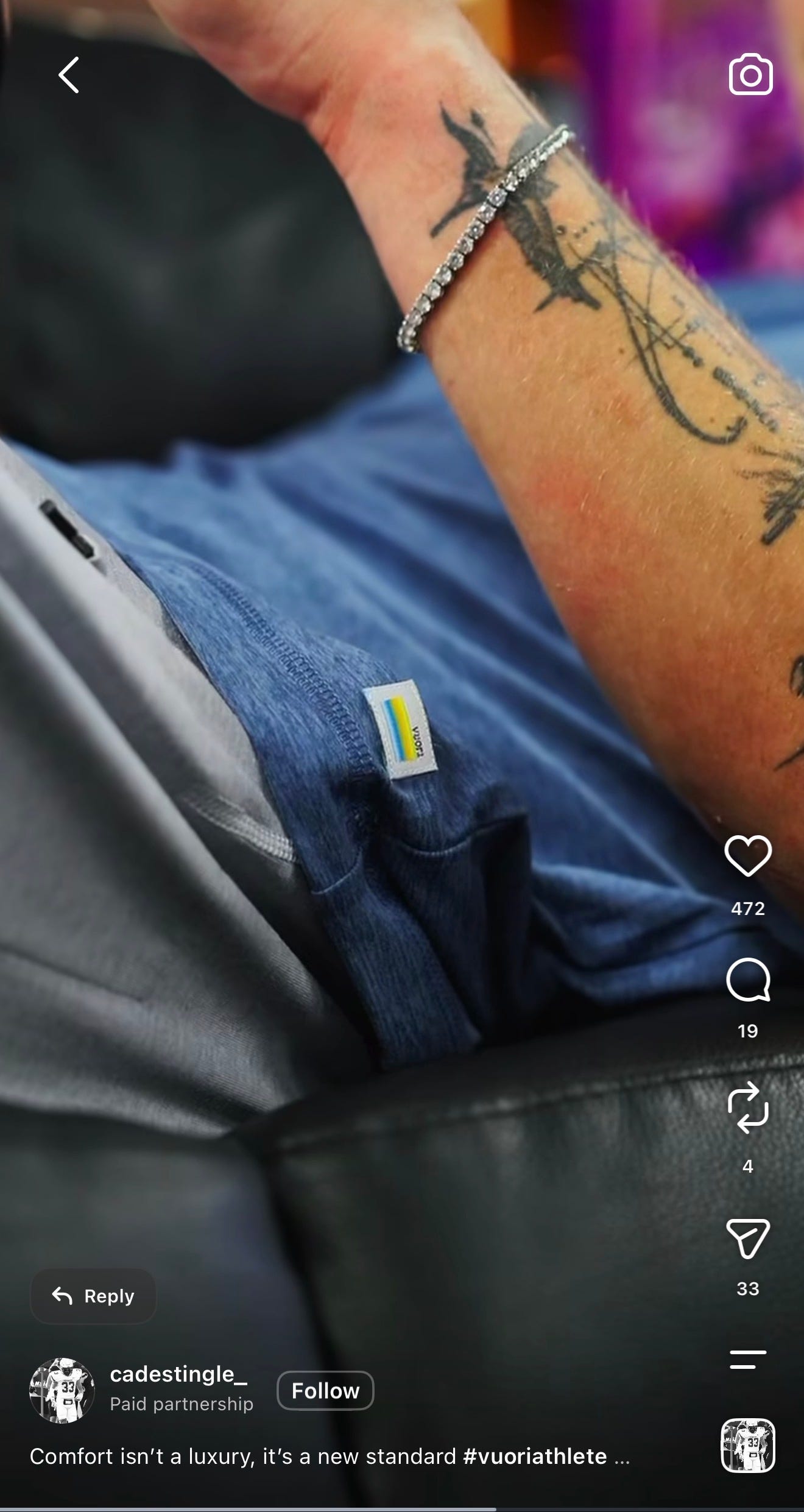
Student-athletes make the content. Brands pay and benefit (allegedly). How many programs are reposting the content as a way to say their athletes have these kinds of opportunities in this program?
4. The report’s five-year plan is three boxes
The closing section is titled “The Next Five Years of NIL” with three bullets about understanding the landscape, clarifying priorities, and building out a framework.
I don’t really think it’s a five-year outlook.
It doesn’t really address what happens to Division II if the NCAA opens rev-share to lower divisions. Or what happens to collectives at schools where the donor base is 40 well-intentioned alums. Or whether the $50 activity has any viable path to become a $100 or $500 activity.
For the record, I don’t think Opendorse or anyone else has those answers. But the title promised a forecast and delivered a checklist, so it’s worth noticing and reminding yourself that:
Nobody has this figured out.
The schools/departments/programs that create a climate that benefits the athlete will see new paths forward to viability.
Waiting for guidance only gets you second place in a two-team race.
A small note of context…
It’s worth mentioning that in this new era of college sports, everything produced in this document is through the Opendorse lens. And I love the people there. Some of my favorites in sports tech.
But every quote on pages 11 and 12 is from an Opendorse customer talking about their Opendorse partnership. The cover athlete is wearing a Vuori shirt from a Vuori deal that presumably ran through Opendorse. The participation stats are “% of Opendorse athletes with commercial NIL.”
Translated, this means that the 58.2% NJCAA figure tells you about Opendorse’s NJCAA users. So really only indirectly about all JuCo athletes.
Same with the 13x. In my estimation, that’s only a 13x value on Opendorse’s book.
And the $25 million is “calculated by extrapolating primary data” from Opendorse transactions. Extrapolated how? The report doesn’t say.
Importantly, none of this makes the numbers wrong. Opendorse has the best vantage point of anyone and the direction they're saying this is headed is almost certainly right.
Just take it with a grain of salt, same as you should with this blog post.
One final takeaway.
In one year, the number of small-college student-athletes doing commercial NIL went from under 2,000 to more than 19,000.
Curiously, activity shot way up while money stayed pretty constant. To me? This is a content problem as opposed to an NIL/money problem.
I have great news.
Content problems are the kind you can actually problem-solve for.
I’ve spent the past 5+ years helping schools and programs solve the content problem. These fixes are tiny in scope, but tremendously valuable. If I had to sum up all of that work into two platitudes, I would say that:
There are no rules against being more creative.
You have to make the changes and be consistent.
Which means any school, large or small, can be a player in this environment.
Note: If you have any questions on this post, their PDF, or anything else… hit me up. I’m here to make sense of all of it.

Thanks for reading.
My name is Jayson Schmidt and I run this little newsletter. I’m a former NCAA Division II head coach, brand strategist across college sports, and I’m now the head of marketing at FanWord — an AI tool for storytelling in college sports.
I’m on a mission to share the future with every stakeholder in athletics, because I’ve seen the impact, both in my own lacrosse program and countless others as a strategic consultant.
More Links:
💡 Suggest a topic: If you have a topic you’d like to see covered, shoot me a message below (or reply if you received this in email form).
🧵 Let’s connect on LinkedIn or Twitter or Threads.
📈 Upgrade to [Future]+ and get deeper dives and best practices for the changing world of college sports.
🚀 Charter Members also get three written social media audits per year, plus a yearly strategy call.
19,000 athletes doing deals for $50 a pop tells you exactly where the leverage is. It's not a money problem, it's a distribution problem - most of these schools have nobody turning up moments into content. That's the gap. Whoever builds the system to capture and push that content out wins the small-school NIL game, not whoever finds bigger checks.